Published on 02 April 2026
Written in Partnership with Five on a Bike
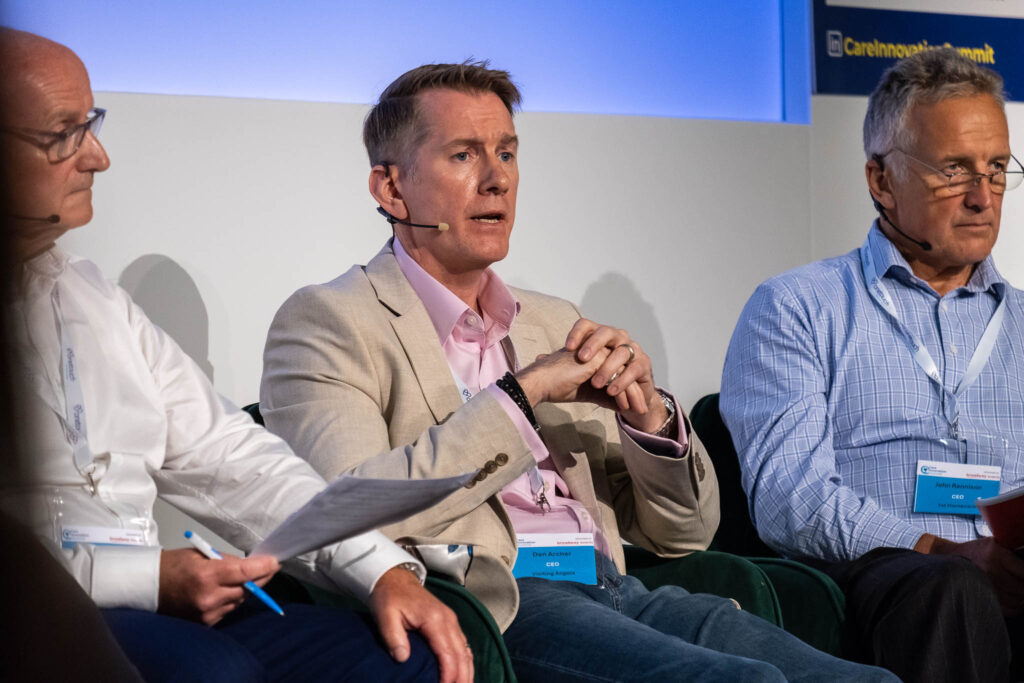
At the Care Innovation Summit 2026, sector leaders explored the future of social care innovation. Among them, Dan Archer, Founder and UK CEO of Visiting Angels, shared a practical perspective on effective domiciliary care leadership in an exclusive interview at the Care Innovators Studio with Five on a Bike.
Since launching the business in 2017, Archer has grown Visiting Angels to around 1,600 staff across 75 UK locations, driven by a focused approach to recruitment, retention and culture. Across the UK social care sector, persistent challenges remain, particularly around workforce incentives, fair pay and supportive working environments.
This article explores those insights, offering practical takeaways for care providers looking to strengthen their leadership approach. For care business owners and senior leaders, the message is clear: improving workforce outcomes starts with rethinking leadership itself.
What Domiciliary Care Leadership Can Learn from Recruitment Challenges
Recruitment challenges across social care are well documented, but Archer argues that many of these issues are structural rather than unavoidable.
He describes outdated workforce models as a “dead man’s shoes” approach. This means progression is slow, reactive and dependent on others retirement, rather than strategically preparing a new workforce for the future.
For those in domiciliary care leadership, this highlights a key issue:
- Recruitment challenges are not just about candidate shortages
- They are often driven by how roles are designed, structured and valued
With over 130,000 vacancies across adult social care, the sector cannot rely on traditional approaches. Leaders must instead focus on making roles more attractive, accessible and sustainable for care workers.
Redefining Domiciliary Care Leadership Through a Carer-Centric Model
A central theme in Archer’s approach is the concept of a “carer-centric” business that places caregivers at the heart of decision-making.
For domiciliary care leadership, this represents a shift in mindset. Rather than focusing purely on service delivery or operational efficiency, the emphasis moves to:
- Understanding the day-to-day experience of caregivers
- Designing systems around their needs
- Recognising their value as the foundation of care quality
As Archer puts it, leadership in this model is about “seeing the world through the eyes of a caregiver”.
This approach aligns closely with wider discussions around social care innovation, where workforce experience is increasingly recognised as a driver of both quality and sustainability.
A Caregiver-First Approach to Domiciliary Care Leadership
One of the most notable outcomes of Dan’s approach is retention. Visiting Angels reports a 91% retention, which is significantly stronger than sector averages.
Putting this into practice requires deliberate and practical changes across workforce leadership.
For Visiting Angels, this includes:
- Providing fair pay and financial security by paying above minimum wage and compensating for travel time
Improving sustainability and demonstrating loyalty by moving away from zero-hour contracts
- Assessing working conditions such as visit time to reduce time pressure
- Monitoring stress and wellbeing by listening and identifying pressure points
- Actively listening to caregivers and acting on feedback
These are not new ideas, but they are not consistently implemented across the sector. However, when small implementations are made, real differences can be seen.
Systemic Challenges Facing Domiciliary Care Leadership
While individual providers can make changes, Archer is clear that wider systemic issues remain.
Many services are commissioned at rates that make it difficult to deliver improved pay, contracts and conditions. This creates a cycle where providers struggle to implement change, even when they recognise the need.
However, he challenges leaders to make the necessary sacrifices needed to support their workforce.
This is particularly relevant in areas such as unpaid travel time and contract structures that leave care workers effectively learning below minimum wage, and with little security.
For those in domiciliary care leadership, this reinforces the importance of balancing commercial decisions with workforce impact.
Building Culture and Belonging in Domiciliary Care Teams
Finally, Dan addresses that a unique challenge in domiciliary care is that the workforce is largely remote. Care workers move between clients’ homes, often with limited interaction with colleagues.
To address this, Visiting Angels focuses on creating opportunities for connection and belonging through face-to-face training, regular engagements and team events.
These initiatives recognise that retention is not only about pay or contracts. It is also about whether individuals feel part of a team.
Where to Start: Practical Steps for Domiciliary Care Leadership
For care providers looking to make changes, Archer’s advice is straightforward: start by listening.
Rather than implementing large-scale changes immediately, leaders should:
- Speak directly with their current team
- Understand what matters most to them
- Identify which changes would have the greatest impact
This approach allows care business owners to move forward in a way that is both practical and truly carer-centric.
The Future of Domiciliary Care Leadership
The challenges facing social care are unlikely to ease in the short term. However, there is a clear opportunity for leadership to drive change from within.
Innovation in recruitment and retention is not solely about attracting new people into the sector. It is about making roles more viable, more respected and more rewarding for those already delivering care.
Domiciliary care leaders have the opportunity to learn from each other’s challenges and successes, and valuable insights, as heard from Dan Archer, and this is a starting point for any care provider to improve their work culture.
To find out more about how you can retain, support and grow your workforce, watch Dan’s full interview on YouTube, and book your ticket for Care Innovation Summit 2026.